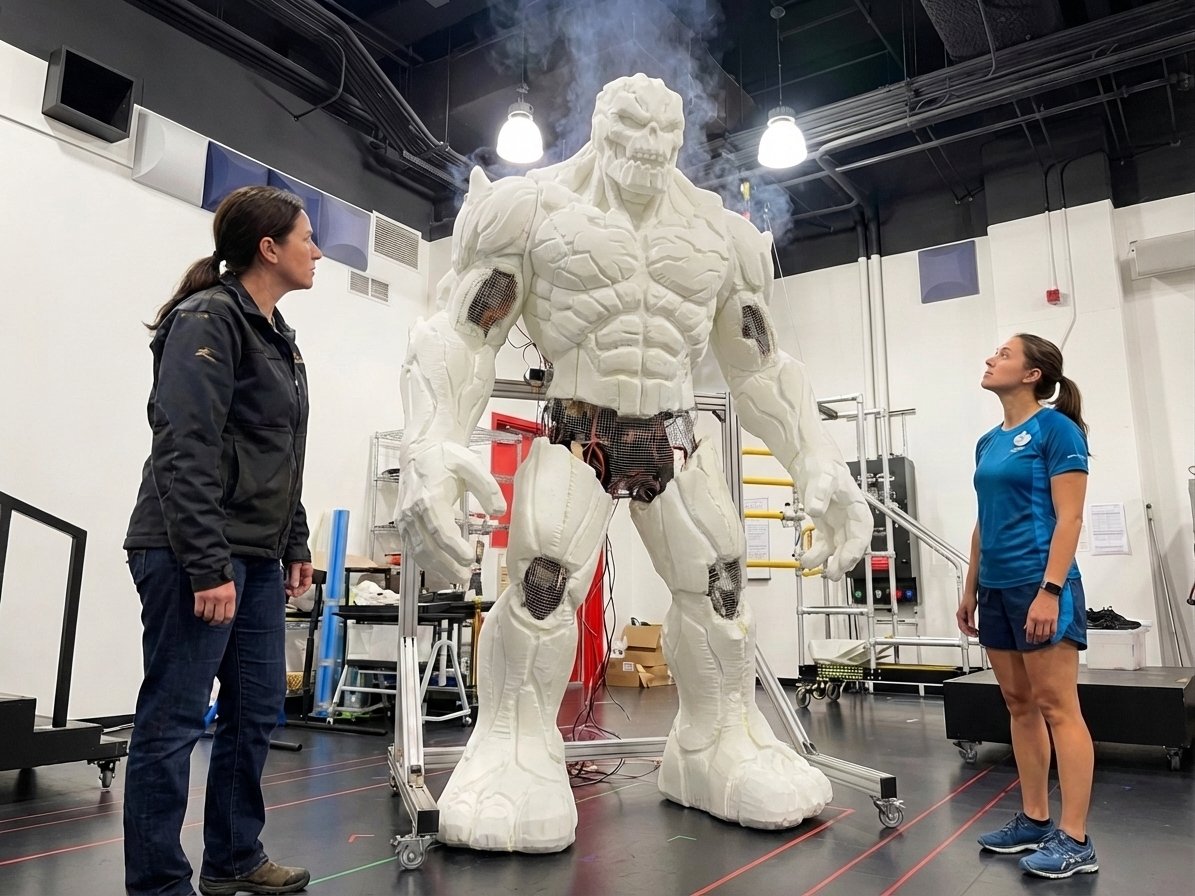
There is a moment in this Broadway-style stage show at sea when two enormous characters rise and tower over the cast on a moving ship. The audience sees gods and monsters. What they do not see is the RXOS exoskeleton system underneath, quietly carrying the load that makes the whole illusion seem effortless.
Guide2WDW tells the full story of the show in detail. We are focusing on the user experience/engineering / and manufacturing challenges that made it work.
The problem: making a Character walk
Stage puppetry is an old craft. Monster-scale stage puppetry on a ship is something else. Ask a single performer to wear that structure, move it convincingly, and do it through many theatrical performances, while the floor pitches and rolls with the ocean, and the usual rules are gone.
The brief sounded simple: make the characters feel massive and alive, keep their movement organic, and make sure the performer inside could do it show after show without their body paying the price.
That last point is the one people tend to skip past. A puppeteer carrying that kind of load with a conventional rig is fighting gravity for the entire show. Do that on schedule, and eventually, you will not have a performer. You have an injury waiting to happen.
Where RXOS comes in
RXOS is our exoskeleton and zero-gravity tool-arm platform. Most of its life has been spent in industrial settings, helping workers push, lift, hold, and carry weight nobody should manage repeatedly on their own – from Lockheed Martin aircraft, Navy shipyards, stadium-sized steel beam fabrication, and the like. The idea is simple: safely and efficiently shift the burden from the operator so they can focus on the work, not their personal wear.
A giant puppet is, mechanically speaking, just another load to manage. So, we took the RXOS foundation and built a custom exoskeleton for this performance. The frame supports the character’s structure. The articulated harness mirrors the puppeteer’s natural movement, so when the performer steps, sways, or shifts, the character does too. Weight that would normally hang from a performer’s shoulders and spine is instead rerouted through the exoskeleton frame.
The numbers make the case. Each character performer carries roughly 70 pounds of costume and another 40 pounds of maneuverability hardware. That means well over 100 pounds of added weight in motion at any given moment. And when the suits come off, these are still performers, which means the engineering must protect the body responsible for a full performance.
Then there is the ocean. A theater that pitches and rolls cannot assume a level floor. The system must account for rough seas, whether that means letting a character ground its fists for stability or adding cane-like icicle supports when the deck refuses to stay still.
The result is what the audience notices and never has to think about. Onstage, the character moves with real, organic grace. Within the system, the performer gets the support needed to make that illusion work for a full run.
Why this matters
As far as we know, this is the first time this entertainment company has used exoskeleton technology this way in one of its productions. Most of our exoskeleton stories have been written on factory floors. Seeing the same engineering logic show up under a character’s costume, on a stage, on a ship, in front of an audience, is exactly the kind of unexpected application that makes this work exciting!
The physics of gravity does not change much between a welder and a mythological monster. In both cases, someone is carrying a weight they would rather not carry alone. All we did was figure out how to carry it for them. One version protects a worker’s back. The other lets a God battle across a theater set at sea. Different setting. Same idea. Applied well.
If you want the full behind-the-scenes story, check out Guide2WDW’s video. And if you have a challenge that might need an exoskeleton miracle to do your heavy lifting, whether industrial, theatrical, or something no one has thought of yet, our creative team would love to connect to learn more.